…and what that still says about AI’s limits
Technology can run half a business these days. AI drafts emails, polishes sales pitches, and even scripts podcasts with unnerving fluency. It can summarise legal documents, translate Old Norse, and give you a marketing strategy in 14 seconds.
But there’s one thing it still can’t be trusted with.
Wordle.
Every so often, usually in the blurry half-light of morning, I’ll be staring at the Wordle grid on my phone. There’ll be two greens, a lonely yellow and a row of greys staring back at me. And I’ll think: Fine. Let’s see what the new, super-clever ChatGPT-5 can do.
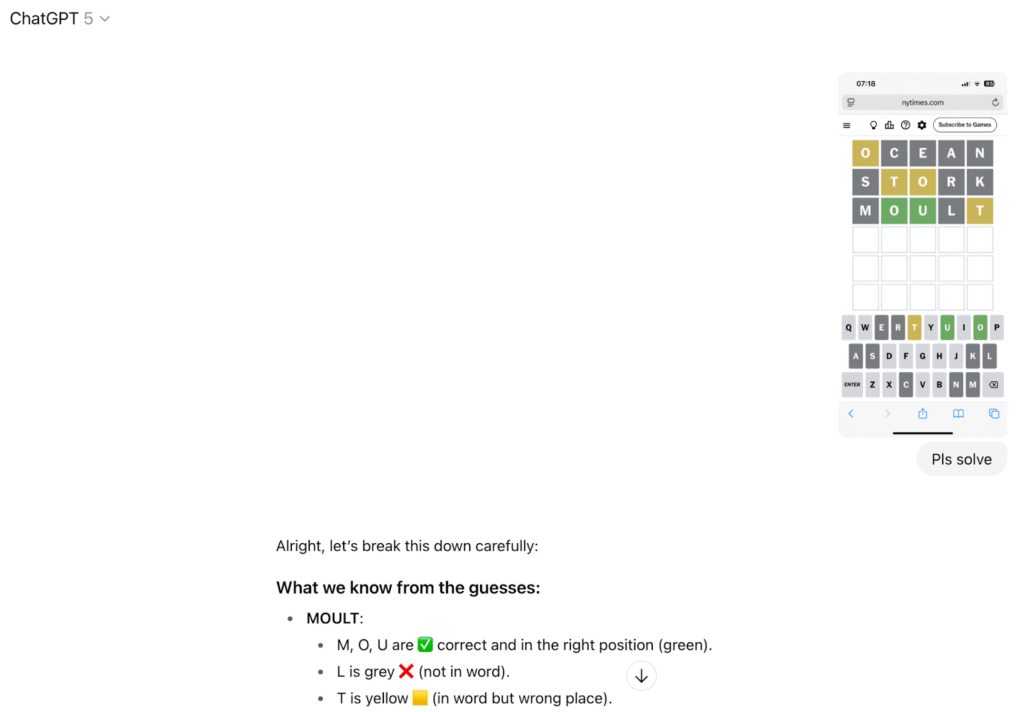
This is nearly always, to my surprise, a mistake. Look at this Wordle (Wordle 1,544) from earlier this week:
The confident disaster
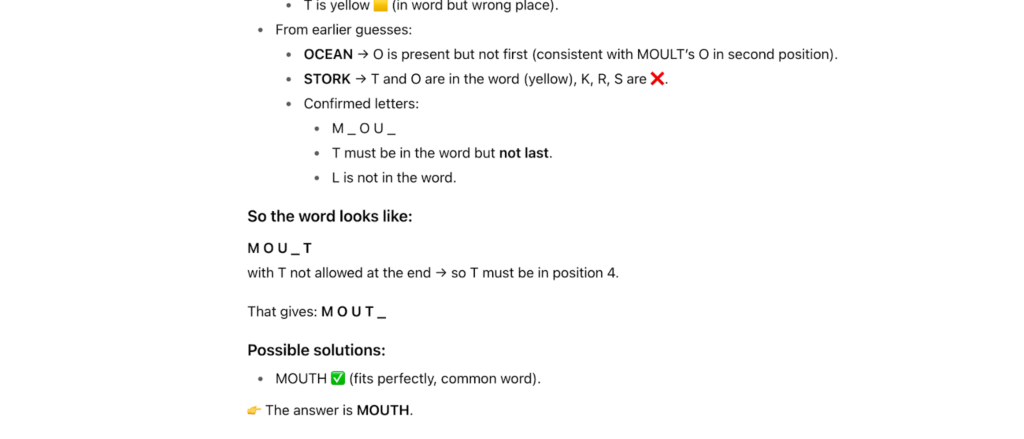
How can it be MOUTH? M is clearly not in the word!
Why it struggles
The problem is possibly structural. Wordle is about constraint and deduction. Every guess shrinks the number of options. Humans do this naturally — we remember what’s ruled out.
ChatGPT-5 doesn’t seem to. Not really. It doesn’t play the game; it describes possible answers based on letter frequencies. It forgets its own mistakes. It hallucinates plausible-looking five-letter words that don’t exist, suggests wrong answers like MOUTH and declares victory. You’ll get something beautifully answered, but the letters don’t add up.
That tells you something useful:
The amazing ChatGPT-5 is brilliant at language — and still terrible at thinking.
We often conflate those two. We assume language is thinking. Wordle proves otherwise. And sometimes, when you’re bleary-eyed at 7.18am trying to work out if the word is MOUTH or MOUNT, it’s comforting to know the machine is just as lost as you are.
(PS It was neither MOUTH nor MOUNT. There is no M! It was a tricky one, with an unusual answer, but I got it on my own. Clue: It begins with P.)