Based on a longer Deep Research project we commissioned which is here. For the need-to-know:
There’s a new paradigm for AI video content: viewers don’t recoil at AI-crafted short video ads on principle. They recoil when a brand uses AI badly. And when brands don’t use AI at all? The audience increasingly reads that omission as an error, or worse, irrelevance. The era of ‘Is AI okay?’ is dead. The era of ‘Why haven’t you made this for me?’ is here.
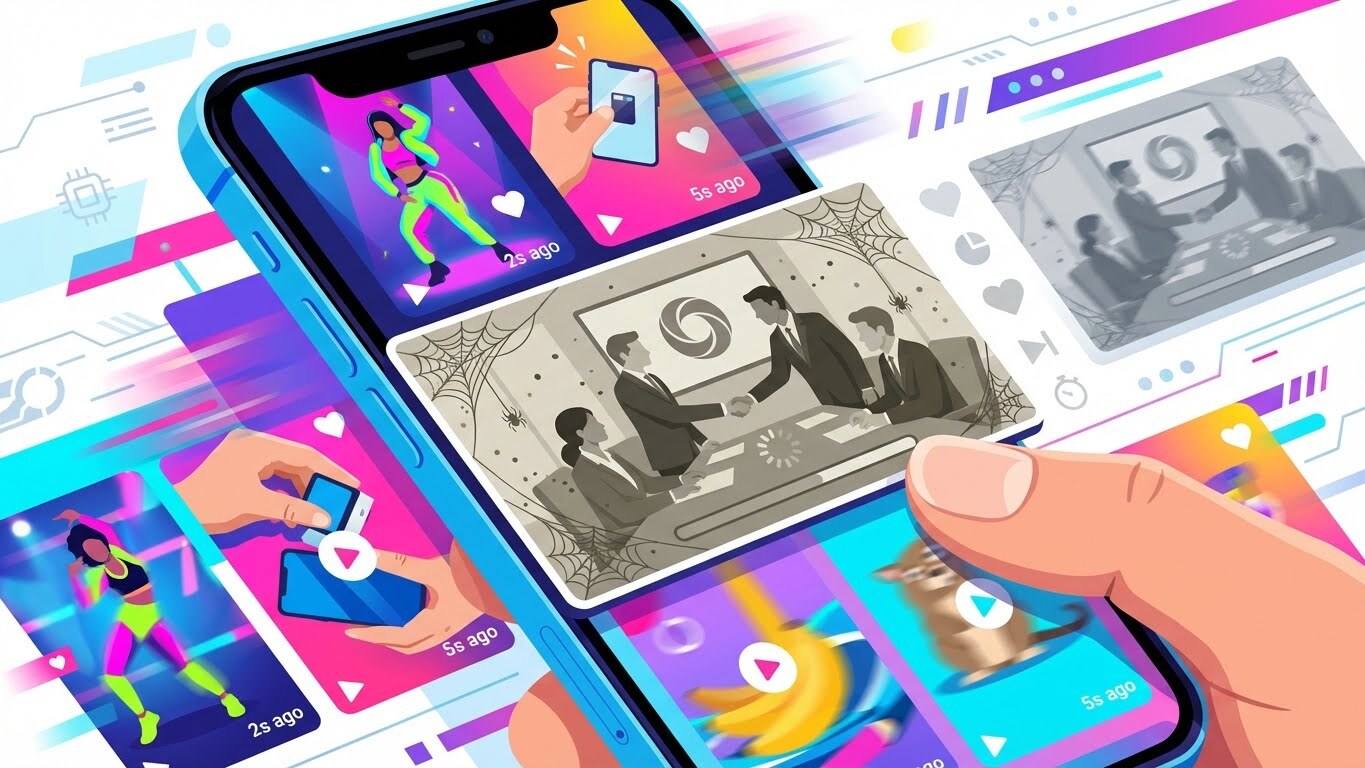
The expectation is not about gloss or gimmicks. It’s about cultural timing, relevance, and technical fluency. Short-form formats (TikTok, Reels, Shorts) burn trends in 3–4 days, sometimes less. That’s not enough time for a conventional production cycle to finish a production. AI, when used well, meets the speed, sharpens targeting, and improves completion rates without the viewer ever caring how the sausage gets made. They expect the outcome more than the method.
So – what’s the evidence? Feel free to browse our longer report, but if not:
The evidence that expectation has overtaken acceptance
- 82% of global internet traffic is video; most of mobile engagement is now vertical, sub-60s content. The feed is relentless and non-negotiable.
- 70%+ of marketers already use AI in weekly or daily ad workflows to keep pace. Consumers assume you’re doing the same.
- 78% of consumers want brand video, yet 44% express frustration when it’s generic. ‘Relevant’ is now a technical standard, not a creative hope.
- UGC styles outperform but AI-assisted hybrids outperform UGC alone on completion, especially when subtitles and jump cuts are AI-generated, but human-performed.
Why this matters in practice
1. Relevance isn’t an optional extra
Consumers don’t want more video in the abstract. They want video that slots into their context:
- A gym-tok user expects kinetic pacing.
- A niche hobby user expects micro-targeted references.
- A local-weather swap in the backdrop increases relevance without being perceived as artificial.
This is no longer optional. It’s assumed, and when absent, noticed.
2. Novelty must feel earned
The data reveals a preference for AI when it’s clearly additive or stylised in ways humans would struggle to replicate manually. For example:
- Coca-Cola ‘Masterpiece’: AI animated paintings passing a Coke bottle across canvases, praised as ‘magical’ (68%+ positive association).
- Toys ‘R’ Us Sora ad: Photoreal founder deepfake, punished for feeling hollow, sentiment plummets.
- Under Armour x AJ remix: Ethical backlash due to perceived labour displacement, not visual technique alone.
The rule of thumb: If it looks like a human, it had better feel like a human. AI can’t borrow humanity wholesale. Only humans have the licence to carry that off.
3. Invisible AI is simply the default
This is where expectation lives. Consumers expect:
- captions that are fast, accurate, and native-looking
- edits that hit the rhythm of the platform
- production at a culturally instant clip.
Watch out for some basic errors
Try to avoid:
- Human mimicry risk: Even high-performing AI avatars can flop on brand sentiment.
- Cognitive ‘slip’: Glossy AI video often registers, but is encoded weakly by the brain.
- Ethics penalty: consumers may want disclosure; younger cohorts treat AI job displacement as hostility.
- Creative homogeneity: Faceless or repetitive AI risks being classed as ‘slop’, which destroys loyalty even if the algorithm temporarily indulges it.
Be critical: AI buys you timing and targeting you can’t get manually. But it borrows nothing of true emotional resonance. A human must carry the weight of story.
How to apply this next week (not next year)
If you want to win — and not just technically — apply AI in places the viewer sees benefit, not fabrication:
- Use text-to-video for spectacle that’s deliberately stylised, never to fake testimony.
- Use AI editing like CapCut Templates to get speed, subtitles, beatsync jump-cuts.
- Keep the footage origin human-performed, micro-imperfect, voice genuine, or at least transparently human-origin.
If your brand video cadence isn’t spending most of its time under 30 seconds and trend-reactive, you will be ignored by both the algorithm and the humans who use it.
Audiences don’t tolerate AI video any more because it looks ‘clever’. They assume AI video because it looks relevant, fast, and beat-accurate. Their expectations come from the platforms they use, and the platforms they use are algorithmic first. A brand that doesn’t match this pace isn’t a maverick purist; it’s invisible.